EVENT BLOG By Fatma Abdelaziz
Cairo, Egypt
28th June 2022
On Tuesday, June 28th, 2022, the Consultative Group on International Agricultural Research (CGIAR) centers held a seminar under the title of "the Global Food Crises and the One CGIAR's Response”, marking the start of the National Policies and Strategies (NPS) for Food, Land, and Water Systems Transformation initiative activities in Egypt. The event was hosted by the International Food Policy Research Institute (IFPRI) Egypt office in Cairo.
In the opening session, H.E. Dr. Nivine Elkabbag, Minister of the Social Solidarity (MoSS), highlighted the collaboration between IFPRI and MoSS, through which MoSS aims to reduce multidimensional poverty and food insecurity in Egypt. Elkabbag said, “We are encouraging households to work on SMEs that are relevant to food security issues because it combines food security and economic empowerment, and this is helping us to expand the 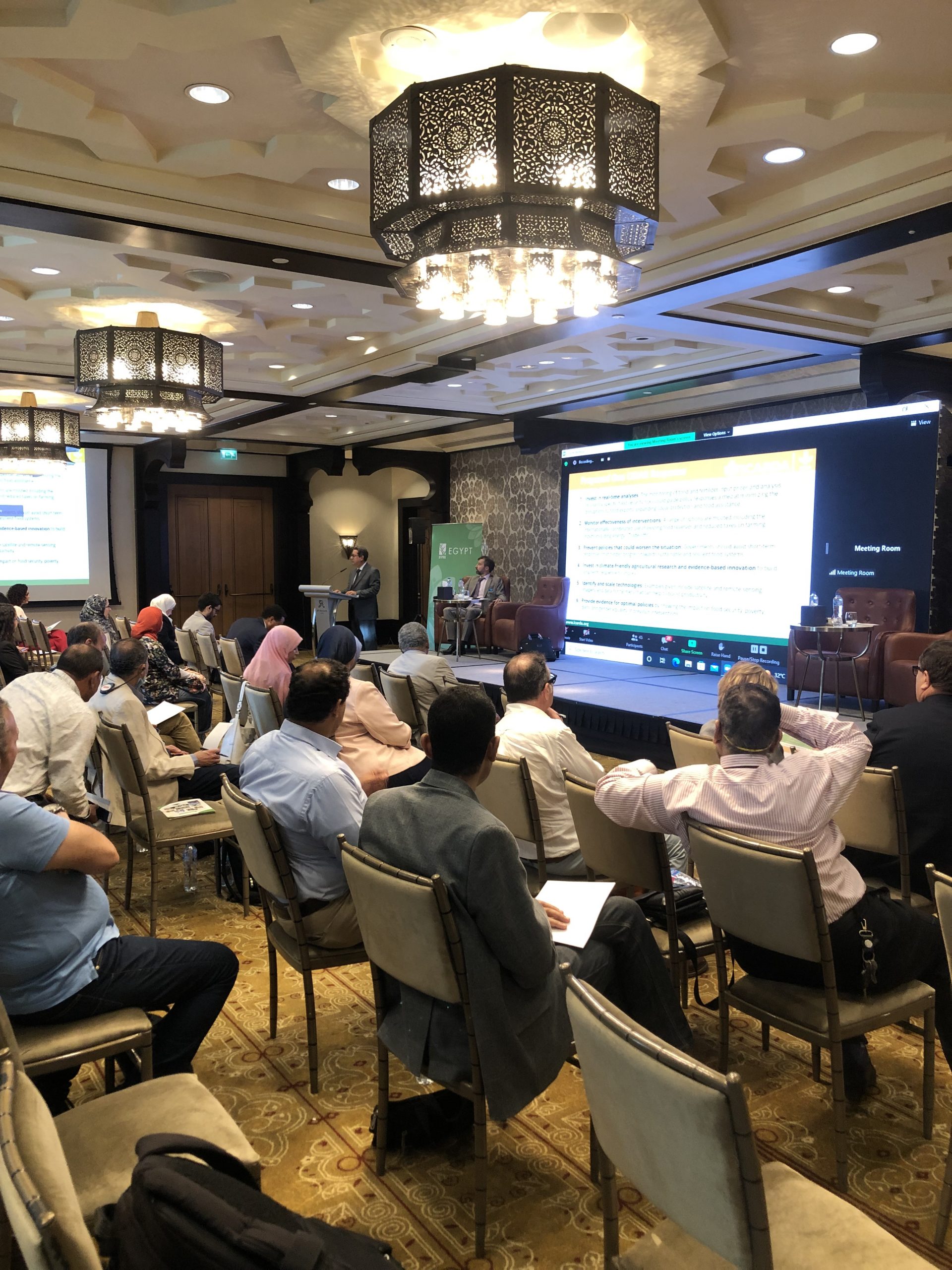 economic side of social protection to socio-economic effects”. Elkabbag summarized the work of MoSS on reducing multidimensional poverty and malnutrition through multiple national initiatives targeting the poorest of the poor by increasing coverage of social protection programs and improving the targeting of these programs. The initiatives include Takaful and Karama, 100 days of life of an Infant, 3000 days of Life of a Child, as well as national school-feeding programs. In the same vein, Elkabbag highlighted the collaboration with IFPRI, including an impact evaluation of Takaful, which is a key move to better understand the population needs where MoSS caters to, and to measure the impact of MoSS’s work on the ground.
On the other hand, Dr. Ahmed Kamaly, Deputy Minister of Planning and Economic Development (MoPED), summarized the reasons of the expected growth-rate decline in Egypt, especially due to the outbreak of the Russia-Ukraine conflict. Kamaly explained that the existing inflation pressure coming from the supply shortage worldwide was further felt in Egypt, being a net wheat importer with 80% of the nations’ supply coming from both Ukraine and Russia. Russian and Ukrainian tourists account for 31% of the total tourist numbers in Egypt, leading to a pronounced dip in Egypt’s tourism revenues. These factors are slowing Egypt's economic recovery and putting pressure on the balance of payment, debt repayment and budget deficit. In addition, the aforementioned economic strains increase the populations’ vulnerability, which translates directly to the need for social assistance, which in turn, increases the pressure on the states' budget. Kamaly added that “We are expecting a drop in private investment in Egypt so the public investment needs to kick in to stabilize the economy, which is problematic because we already have budget deficit and at the same time, we need to have more social protection to face the rising inflation and decreasing purchasing power among Egyptians”. Kamaly concluded his speech noting that during such economic circumstances, any government would need to introduce austerity measures.
Channing Arndt, Director of the Environment and Production Technology Division (EPTD) at IFPRI, highlighted the long-term collaborations between IFPRI and several line ministries in Egypt, including on-going initiatives and collaborations with MoPED (on Hayah Karima evaluations) as well as evaluations on Takaful and Karama and Forsa programmes with the Ministry of Social Solidarity and the other collaborations on climate change and agricultural foresight with the Ministry of Agriculture and Land Reclamation (MALR). Channing explained that the new CGIAR structure includes the National Policies and Strategies (NPS) initiative at its core. NPS focuses on building policy coherence, integration of policies and responding to crises.
Aly Abousabaa, Regional Director, Central and West Asia and North Africa (CWANA), CGIAR and Director General for the International Center for agricultural Research in the Dry Areas (ICARDA), explained further how “One CGIAR” can lead to collective responses through investing in real time analysis, monitoring the effectiveness of interventions, preventing policies that can worsen the situation, investing in climate-friendly agricultural research, identifying and scaling technology. Abousabaa also focused on the importance of exploring new ways to deal with crises. For example, with the wheat market crisis, Egypt can utilize mixed flour composed of both wheat and barley while expanding the barley production in marginal lands, which can be achieved with low water usage. Accordingly, this can reduce dependence on wheat without compromising the taste.
During the second session, Nasredin Hag Elamin, Food and Agriculture Organization (FAO), Egypt Country Representative, emphasized two major points. First, he highlighted the importance of building on national solutions, including the establishment of national coordination mechanism for food systems in Egypt, as well as focusing on policy and community practice
Additionally, Tahani Sileet, Head of Central Department for External Cooperation at the Ministry of Water Resources and Irrigation (MoWRI), highlighted the rising pressure on water resources to increase the agriculture production over the years vis-à-vis the rise in global population. In addition, Sileet pointed out that water scarcity is a major problem facing Egypt with the declining and already below-average-per-capita share of drinking water.
David Laborde, a Senior Research Fellow at IFPRI, highlighted the deficiency of the current food system to accommodate the consequences of the on-going food crisis instigated by the Russia-Ukraine conflict, where the two countries, combined, produce 12% of the world calories. Laborde further emphasized the need for safety nets to support vulnerable households.
Pertaining to the third session, Clemens Breisinger, NPS Initiative Lead and MENA Regional Program Leader at IFPRI, explained how the NPS can bring a lot of aspects and perspectives together to solve multidimensional issue that requires multidimensional solutions. Breisinger also explained that the role of the NPS program, is about policy communication and coherence across relevant institutions, research-based policies, and capacity strengthening.
Alan Nicol, NPS Initiative Co-Lead and Director of Water, Growth and Inclusion at the International Water Management Institute (IWMI), insisted that transformation is instrumental to solve some of Egypt's main issues during the current food crisis, including population growth that puts Egypt's food and energy systems under enormous stress. Thus, the existence of a national and coherent policy is crucial to connect the different aspects of such a multidimensional problem.
In the last session, “Presentations from other One CGIAR Initiatives Operating in Egypt”, Michael Baum, Initiative Lead of the Fragility to the Resilience in Central and West Asia and North Africa initiative (F2R-CWANA), elaborated on the F2R-CWANA initiative and associated research and development activities in Egypt and other CWANA countries. Similarly, Renaud Mathieu, Senior Scientist at the International Rice Research Institute (IRRI) described the “Digital Innovation and Transformation” initiative, which aims to support digital transformation in several countries.
Lastly, during the closing session, Yousef Brouziyne, IWMI’S Egypt Country Representative, insisted on the need to coordinate between various CGIAR initiatives and national institutions.
Kibrom Abay, IFPRI Egypt Country Program Leader, concluded by highlighting the needed follow-up actions and steps for the NPS initiative particularity in Egypt to further support and scale up partnerships with the MoPED, MoSS and other stakeholders. Abay also mentioned the launching the NPS seminar series in Egypt as a platform for policy discussions and partnerships.
Visit Event Page to See Proceedings
Follow IFPRI EgyptSSP on Twitter
Share this blog on social media: