Informing Food Systems Policy in the MENA Region and Looking to the Future
Event blog by Ali Abdelhadi
On December 10, 2025, the International Food Policy Research Institute (IFPRI) organized the MENA launch event of the 2025 Global Food Policy Report (GFPR) in Cairo, under the title: “Celebrating 10 Years of IFPRI Cairo Office: Informing Food Systems Policy in the MENA Region and Looking to the Future.” The event marked the 50th anniversary of IFPRI and a decade of IFPRI’s presence with a local office in Cairo.
The seminar highlighted IFPRI’s long-standing collaborations and research contributions in Egypt featuring key government partners including the Ministry of Planning, Economic Development, and International Cooperation (MOPEDIC), Ministry of Social Solidarity (MoSS), Ministry of Water Resources and Irrigation (MWRI), Ministry of Agriculture and Land Reclamation’s Agriculture Research Center (ARC) and the Institute of National Planning (INP). International development partners, such as the World Bank, GIZ, and UNICEF also participated in the launch.
The event was opened with recorded remarks by H.E Dr. Rania Al-Mashat, Minister of Planning, Economic Development, and International Cooperation. “Today we celebrate both a flagship publication and a partnership that made evidence central to the policy-making … We value the insights shared in the 2025 Global Food Policy Report, which presents a clear and comprehensive lens on food systems, climate resilience, agricultural transformation, and the broader socio-economic dynamics shaping development today,” said Dr. Al-Mashat.
Dr. Steven Were Omamo, IFPRI Director for Africa, noted that launch was taking place at a time of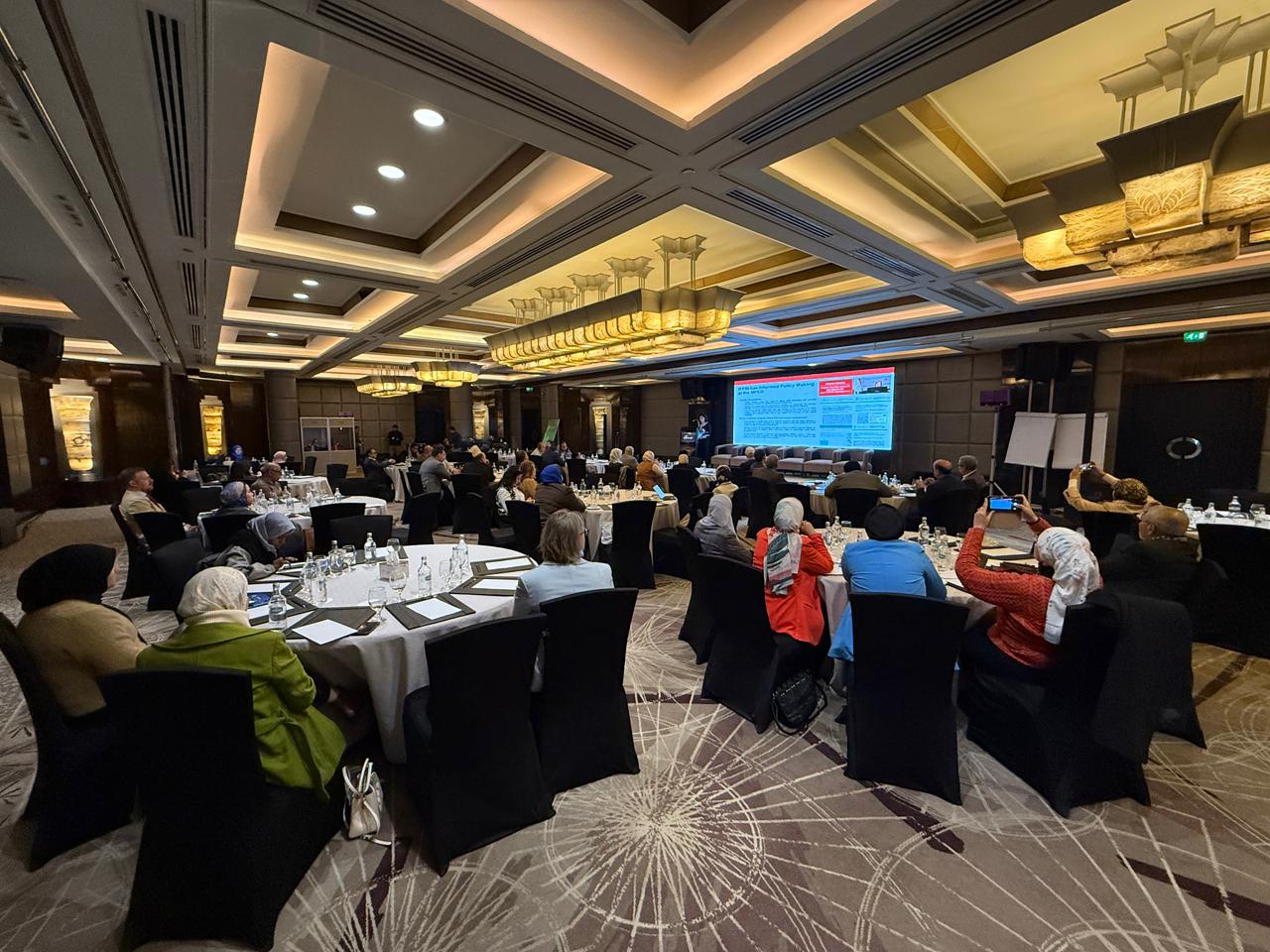 mounting pressures on food systems across the MENA. He highlighted the challenges of high import dependence, urbanization, and demographic transformation as well as potential solutions in water-smart technologies and regenerative practices, private sector innovation around food logistics, retail and urban supply chains, and leadership among youth and women entrepreneurs across the agri-food space. Dr. Omamo said, “The Global Food Policy Report of 2025 underscores the importance of integrated policy action.”
Speaking on behalf of the IFPRI Cairo office, Dr. Sikandra Kurdi, Egypt Country Program Leader, reviewed the past and present of food policy research in MENA. Her presentation provided an overview of the key milestones and trends of food policy research in the MENA over the past 50 years. Subsequently, Ms. Fatma Abdelaziz, Senior Research Associate, IFPRI, presented on key achievements of IFPRI’s work in Egypt over the past 10 years including joint research and informing policy for key government partners in Egypt: the Institute of National Planning (INP), and Central Agency for Public Mobilization and Statistics (CAPMAS), Ministry of Social Solidarity (MoSS) and Ministry of Agriculture and Land Reclamation (MALR).
In two panel discussions, IFPRI partners shared perspectives on the value of research for policy in Egypt. The first session focused on agricultural policy and investment planning. The panel members included Eng. Walid Hakiki, Head of Planning Sector, Ministry of Water Resources and Irrigation (MWRI), Dr. Mohamed Ali Fahim, Head of Climate Change Information Center (CCIC), Ministry of Agriculture (MALR), Dr. Mariam Raouf, Head of Modeling Unit, Institute of National Planning (INP), and Mr. Hassan El Badawy, Agri-digital Solutions Advisor, Agricultural Innovation Project (AIP), Deutsche Gesellschaft für Internationale Zusammenarbeit (GIZ).
When asked about the key lessons learned regarding the role of data and forecasting models in supporting decision-making, Dr. Fahim said, “We benefited from IFPRI's approach, which emphasizes that accuracy builds trust.” Dr. Fahim praised the significant results of the collaboration with IFPRI on the Climate Change Future Watch project.
Mr. Hassan El Badawy, Agri-digital Solutions Advisor at GIZ spoke about the role of research in informing digital agriculture extension interventions. He said, “Of course, the study that GIZ did with IFPRI clarified many things for us, most importantly, that the design of any application must be as simple as possible, and that farmers benefit more when they receive daily or weekly follow-up from someone who calls them to check if they've used the application, how they've used it, and even if they remember how it actually works.”
Dr. Raouf described the economic modeling unit at INP which was established approximately 4 years ago with technical support from IFPRI. She noted that, “Making decisions or policies based on information, evidence, indicators, or outputs makes those policies more credible or defensible.”
The second panel which focused on social protection and nutrition policies included Mr. Mohsen Sarhan, CEO, Egyptian Food Bank, Mr. Medhat Abdelrashid, Consultant for Economic and Social Empowerment and Head of Environmental and Social Protection unit at MoSS, and Ms. Souraya El Assiouty, Task Team Leader and Social Protection Specialist, World Bank.
“Our partnership with MoSS and IFPRI has been standing for several years now, I am happy and proud that one of the first and certainly the biggest randomized control trial to be conducted on a charity organization like EFB was with MoSS and IFPRI,” stated Mr. Sarhan.
Mr. Medhat Abdelrashid said, “As we are moving from cash subsidies to economic empowerment, we had the Takaful and Karama in place for long years now and there was a state of dependability on cash transfer. In order to change that, we couldn’t work randomly and this where research comes in.”
Ms. Souraya El Assiouty also stressed the value of research. “For us at the World Bank, research and impact evaluation are an integral part of our work. It was very important for us—and for the government as well—that when working on a national program as large as Takaful and Karama, we invest in understanding the program’s impacts, the relative benefits of cash transfers versus in-kind assistance, and how cash transfers affect households’ health, nutrition, food security, and overall welfare, which we did through the impact evaluation with IFPRI.”
The event concluded with an engaging Q&A session, during which audience actively exchanged perspectives and reflections. Guests expressed strong appreciation for the event, highlighting the value of an event that fosters open discussion on the role of evidence in informing food security and decision-making.