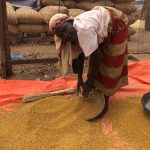
Quantifying the impact of the COVID-19 pandemic on poverty in Africa has been as difficult as predicting the path of the pandemic, mainly due to data limitations. The advent of new data sources, including national accounts and phone survey data, provides an opportunity for a thorough reassessment of the impact of the pandemic and the subsequent expansion of social protection systems on the evolution of poverty in Africa
NEW PUBLICATION: Digital tools and agricultural market transformation in Africa: Why are they not at scale yet, and what will it take to get there?
Despite enthusiasm for the potential of digital innovations to transform agricultural markets in Africa, progress made thus far has been limited to small-scale experiments that often fail to scale up. Realizing the full potential of digital innovations – tools, technologies, applications, and services – in Africa requires not just further development of these solutions at meaningful scales, but also more nuanced evidence from both successful and unsuccessful scaling efforts
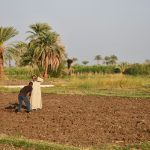
NEW PUBLICATION: Smallholder farmers’ participation in profitable value chains and contract farming: Evidence from irrigated agriculture in Egypt

The participation of smallholder farmers in high-value and profitable value chains as well as contract
farming remains low in Africa. This paper aims to identify observable and unobservable constraints that
explain joint participation in profitable value chains and contract farming
2023 Global Food Policy Report: Rethinking Food Crisis Responses

The past decade has been marked by multiple, often overlapping, crises. The COVID-19 pandemic, various
natural disasters, and the ongoing war in Ukraine have all threatened the fabric of our global food systems. This string of crises has left an indelible mark. In too many places, progress in reducing poverty and
malnutrition has been reversed, with long-term implications for people’s health and livelihoods
NEW PUBLICATION: Evaluating cereal market (dis)integration in less developed and fragile markets: The case of Sudan

This paper evaluates spatial market integration in cereal markets in Sudan, focusing on wheat and sorghum, two major cereal crops. Sudan’s context provides important insights on the functioning of markets in economies marred by sanctions, conflicts, soaring inflation, and macroeconomic imbalances. We use long-ranging monthly cereal price data and a vector of error-correction cointegration model (VECM) to characterize both short-term and long-term spatial price adjustment across cereal markets
- « Previous Page
- 1
- …
- 5
- 6
- 7
- 8
- 9
- …
- 39
- Next Page »