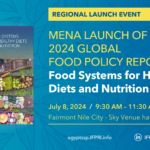
The International Food Policy Research Institute (IFPRI) 2024 Global Food Policy Report (GFPR)outlines strategies to improve diet quality and nutrition in low-and middle-income countries. It highlights the necessity for diets that are beneficial for both individuals and the environment, examining demand-side strategies, cost-effectiveness, and the enhancement of food environments.. The report serves as a platform to address the pressing challenges faced by the world today, underscoring the significance of healthy diets in combating all forms of malnutrition. Malnutrition remains a major issue, significantly affecting children and leading to conditions such as obesity and various diseases. Its effects are felt both in the short and long term, resulting in numerous deaths attributed to malnutrition. In recent years, there has been a growing commitment to improving nutrition. Accordingly, the report seeks to identify sustainable, healthy diets—those that provide essential nutrients for a healthy life while also considering environmental impacts.
VACANCY: Program Manager

Reports to: Egypt Country Program Manager Location: IFPRI Egypt, Cairo Click here to Apply Main purpose of position The International Food Policy Research Institute (IFPRI) seeks a Program Manager for Egypt Projects who will focus on the Egypt portfolio to help us keep organized and take over some of the project management workload. The incumbent will […]
BEP Seminar Series | Roundtable Discussion | Targeting in Development projects: Approaches, challenges, and lessons learned
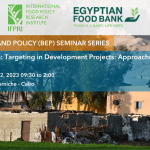
SFSD, EFB, and IFPRI are excited to announce a forthcoming session as a first the second in the Bridging Evidence and Policy (BEP) Seminar Series. This upcoming session will take the form of a roundtable discussions, gathering experts and development implementers around the theme of “Targeting in Development Projects”. Targeting eligible beneficiaries in governmental and non-profit development programs is a challenging endeavor that requires a deep understanding about the different methodologies, and which is suitable for each program.
BEP Seminar Series Launch – Media Coverage
Media Coverage in English Food Today article (Web) Egyptian Streets (Web) Egyptian Streets (Instagram) Media Coverage in Arabic: Food Today (@foodtodayeg) (Instagram) Youm 7 AlMasry AlYoum Shrouk News Sout AlOmma Dostor Ahram Akhabr Alyoum Video Interviews (Arabic and English): Food Today: Video – Dr. Karamany and Eng Noura Food Today: Video – Mr. AbdelRahman and Dr. Kibrom
BEP Launch – Speakers’ Biographies
Visit the event page here to view the detailed agenda and event proceedings Speakers from the Public Sector H.E. Nevine El-Kabbaj H.E. Nivine El Kabbag is the Minister of Social Solidarity. She has more than 25 years of experience in development policies, social protection, childhood protection, strategic planning, monitoring, and evaluation. She has also served […]